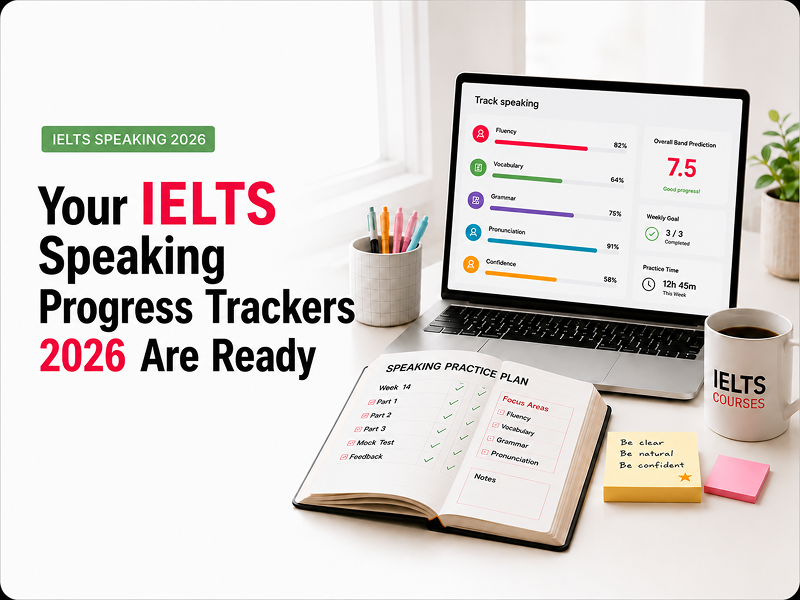



That's exactly why I created these progress trackers.
Why I started making them
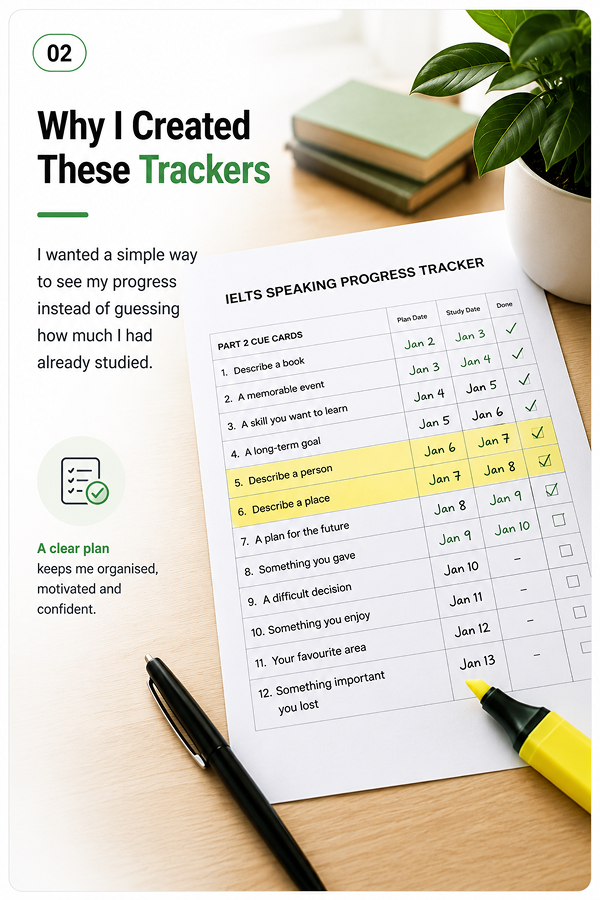
When I was preparing for IELTS myself, I studied topic by topic. The problem was that I never really knew how much I'd already covered or how much was still left. I would open my notes, jump between topics, and constantly feel like I wasn't making enough progress.
So I created a very simple tracker for myself. Nothing fancy. Just a list of topics, a place to write the date when I planned to study each one, and a box to tick when it was done. It made a huge difference.
Instead of wondering whether I was making progress, I could actually see it. At first, I shared the tracker with my private students. They found it so useful that I later made it available to everyone through the IELTS Speaking Assistant app, our website, and social media. Since then, we've created a new progress tracker every time IELTS releases a new set of speaking topics, and many students now look forward to each new edition.
Which tracker should you download?
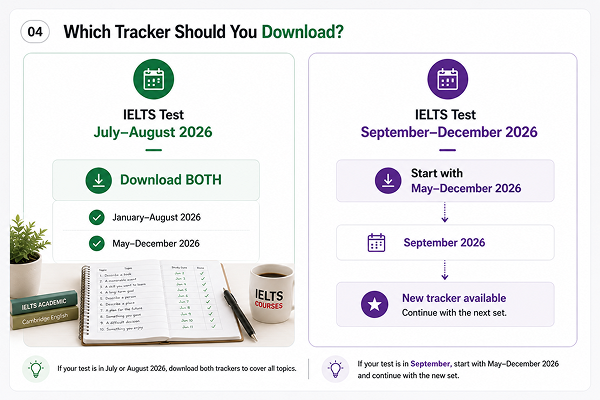
If your IELTS test is in July or August 2026, download both progress trackers.
✅ January-August 2026
✅ May-December 2026
You should prepare every topic from both lists, as both sets may appear in your speaking test.
If your IELTS test is in September, October, November or December 2026, start with the May-December 2026 progress tracker.
Our recommendation is to finish these topics during July and August.
In early September, we will publish a new progress tracker covering September 2026-April 2027 topics. Once it becomes available, simply continue your preparation with that new set.
This way, you won't have to learn everything at the last minute.
https://ielts-assistant.s3.amazonaws.com/book/IELTS-speaking-study-planner-May-December-2026.pdf
https://ielts-assistant.s3.amazonaws.com/book/IELTS-speaking-study-planner-January-August-2026.pdf
How to use your progress tracker
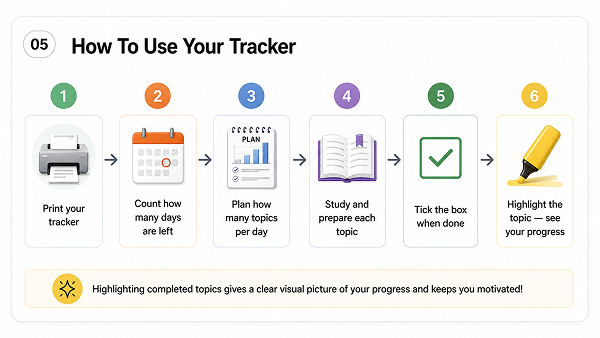
- Print your tracker.
- Count how many days are left before your IELTS test.
- Divide the total number of topics by the number of days you have left. This will show you how many topics you should prepare each day.
- Write a study date next to every topic.
- Tick the box when you finish it.
Personally, I like to go one step further. I don't just tick the box. I also highlight the entire topic with a yellow highlighter. Seeing more and more topics highlighted gives me a clear visual picture of how much I've already completed and how little is left. I find it incredibly motivating.
My recommendation
Plan all Part 2 cue cards first. They are the most demanding part of the Speaking test, so make sure every cue card has a place in your study plan.
If you have extra study time, gradually add one Part 3 topic and one Part 1 topic each day.
Where can you study these topics?
Both progress trackers simply help you organise your preparation. The actual learning happens inside the IELTS Speaking Assistant app.
Every current IELTS speaking topic includes:
- model answers written by IELTS experts
- useful vocabulary
- Band 6 and Band 7+ grammar
- ideas to develop your answers
- all current Part 1, Part 2 and Part 3 questions
The topics in the app are clearly labelled "January-August 2026" and "May-December 2026", so you can easily find exactly what you need to study.
Download your progress tracker, make your study plan, and start ticking off topics one by one.
Small steps every day are much more effective than trying to prepare everything during the last few weeks before your test.